Taxonomy in Materials Registration: the complete guide to structuring, classifying, and governing data efficiently.
Tempo de Leitura: 8 min.
How correct categorization supports the quality of records, improves purchasing, and strengthens materials management in industrial companies.
Taxonomy in material master data is one of the invisible—yet crucial—pillars of master data management. It organizes, connects, and gives meaning to the information that circulates between purchasing, maintenance, inventory, tax, accounting, and various areas that depend on precision and standardization to operate.
What is taxonomy in materials cataloging?
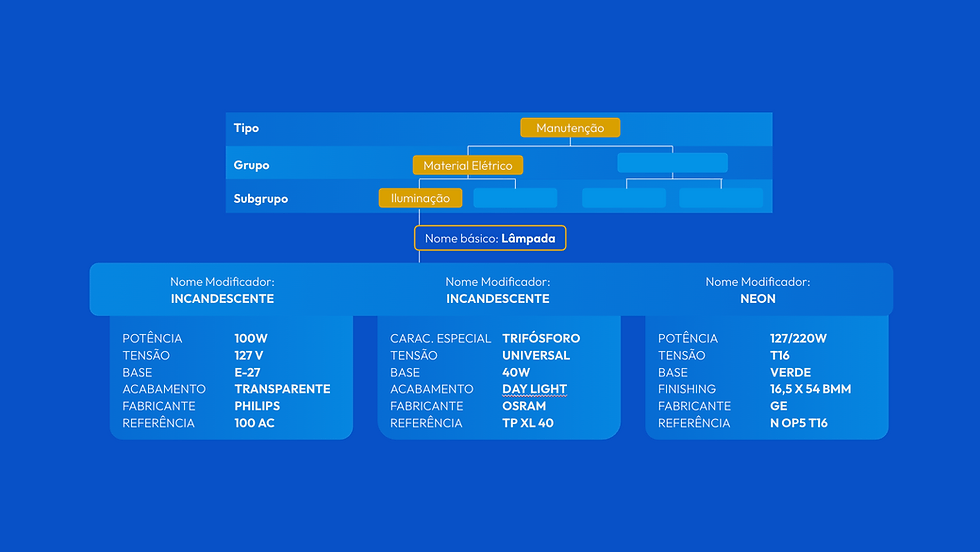
Taxonomy is the division of items into groups based on similarity, according to their characteristics and functions.
The idea comes from biology, but in a corporate context it's linked to the logical organization of information. It's the foundation that allows structuring a large mass of items into coherent groups, facilitating their use, management, and decision-making.
In practice, taxonomy in material catalogs :
It groups items that perform the same function.
Arranges the base to allow controls
It increases clarity for all areas.
It reduces ambiguities and duplications.
It makes finding items easier.
Improves management analysis and reporting.
It allows the application of governance processes.
These groupings are fundamental for materials , services , suppliers , and even customers —but here the focus is on the area of materials.
Why is taxonomy essential for materials management?
According to experts at CH | Astrein, a company may have a robust ERP system, good purchasing processes, and structured indicators—but without a consistent taxonomy, all of this operates on unstable ground.
Taxonomy serves as the "skeleton" of the database: without it, any effort to organize registries risks collapsing.
This happens because:
1. It supports operational processes.
Purchasing, maintenance, inventory, and finance all depend on proper classification to interpret data, plan purchases, ensure material availability, and apply tax or accounting rules.
2. It guides the search and location of items.
Poorly classified items lead to rework.
Duplicate items increase costs.
Hidden items create operational risks.
3. It facilitates managerial analysis.
Reliable reports depend on consistent groupings. Without them, the analyst begins to see:
duplicate families
incomplete items
misaligned information
distorted indicators
4. It improves strategic decisions.
From purchase planning to the annual budget, everything hinges on the clarity—or confusion—of the classification.
5. It reduces costs.
A well-designed taxonomy:
avoid unnecessary purchases
reduces the number of identical items
It facilitates the use of approved contracts and suppliers.
improved predictability
The relationship between taxonomy and the quality of descriptions.
It's no use having a well-structured taxonomy if the descriptions underneath it are poor.
This is the most common mistake found by CH | Astrein in sanitation projects. Many companies believe that reorganizing the taxonomy will solve its problems — but they ignore the fact that:
A poorly written description can place the item in the wrong group.
The description may not allow you to distinguish functionalities.
The description may limit the managerial use of the taxonomy.
There is no such thing as a perfect taxonomy with imperfect data.
Therefore, the correct process always involves two simultaneous approaches:
1. Adjust the structure (taxonomy)
2. Thorough review of the descriptions
They complement each other. One cannot live without the other.
What taxonomies exist? And why is none of them perfect?
All market taxonomies are good — but none are perfect.
Among the best known:
UNSPSC
eClass
Federal Supply Classification (widely used by CH | Astrein)
These structures are extensive, comprehensive, and well-established. However:
They don't cover all sectors.
They don't meet very specific needs.
They have gaps when applied to industries with OEM (Original Equipment Manufacturer).
They have levels of granularity that may be insufficient or excessive depending on the case.
Even large companies always need customization .
The CH | Astrein team emphasized that when applying any standard taxonomy to a client, it is invariably necessary to adapt families and subfamilies to reflect operational reality.
The biggest challenge of taxonomy: OEM (Overall Equipment Manufacturer) items.
This point was widely discussed.
OEM items are those produced specifically by equipment manufacturers. Examples:
plates
modules
cylinder heads
machine nozzles
exclusive components of filling machines
internal parts of complex industrial equipment
The problem is that:
These items don't fit well into traditional taxonomies.
A "sign," for example, could be:
electronics
wooden
metal
Categorization depends on context.
The taxonomists at CH | Astrein explain that, for OEM, no taxonomy is granular enough — and if you try to "force" it, the database explodes into thousands of irrelevant families.
Therefore, the process is always one of intelligent minimization , not of absolute solution.
A single taxonomy for the entire company: the most common pitfall.
Many companies try to create a single taxonomy to cover accounting, tax, purchasing, maintenance, and inventory—and it simply doesn't work.
Why?
Why:
Each area has different objectives.
Each area uses the item differently.
The same item can be interpreted with different logics.
ERPs typically only have one field for sorting.
This generates:
conflicts between areas
family duplication
duplicate items
inconsistent reports
wrong decisions
At a large company served by CH | Astrein, the scenario was exactly this: different departments fought to impose their views on the taxonomy, resulting in absolute chaos.
The solution? Moderation and balance in customization.
Brazilian taxonomy vs. international matrix taxonomies
Taxonomies imported from foreign sources generally perform poorly in Brazil.
This happens because:
Brazil is one of the most mature countries in the area of supply chain management.
Brazilian purchasing professionals tend to operate with higher efficiency than the average in the US and Europe.
Taxonomies from elsewhere do not reflect local processes.
The parent company has not always been flexible enough to understand the Brazilian reality.
Thus, multinational companies established in the country frequently exhibit:
rigid taxonomies
disconnected classifications
meaningless groupings
inadequacy to the national market
In this scenario, CH | Astrein aims to guide clients on alternatives within the limitations of the ERP system, mitigating the impacts of this foreign structure.
Taxonomy in materials cataloging in practice: principles applied by CH | Astrein
1. Every item must originate within the taxonomy.
The classification process is not the final stage, it's the initial stage.
2. The same taxonomy is applied to all CH | Astrein clients.
Even when the customer has their own model, the company classifies them by both to ensure consistency.
3. Customization is inevitable — but it must be controlled.
The goal is to organize processes, not to unnecessarily inflate the structure.
4. Items need to be easy to find.
This is the most important criterion.
5. Management reports should reflect reality.
Poor taxonomy → false indicators → incorrect decisions.
6. Descriptions must be complete.
The best taxonomy in the world doesn't compensate for bad descriptions.
The most common errors in the use of taxonomy in material cataloging.
Based solely on the discussion, the most common mistakes are:
1. Believing that taxonomy alone solves everything.
Without data cleansing, it won't be solved.
2. Use a single taxonomy for all areas.
Conflicts and duplicity are inevitable.
3. Not considering the challenge of OEM items.
They require special treatment.
4. Creating taxonomies that are too extensive.
It increases confusion and makes maintenance more difficult.
5. Allow the area to customize its view without governance.
It completely fragments management.
6. Copying international taxonomies without adaptation.
Imported models rarely work in Brazil.
7. Start the project with the taxonomy, not the data structure.
Poor descriptions distort the entire model.
How to apply taxonomy to material cataloging efficiently.
Based on the implicit methodology of CH | Astrein, the correct path involves:
1. Initial diagnosis
Identify:
quality of descriptions
duplicates
inconsistencies
ERP maturity
challenges by area
2. Definition of the base model
Select the initial structure:
UNSPSC
eClass
Federal Supply
Internal customer taxonomy
Hybrid taxonomy
3. Controlled customization
Adapt:
families
subfamilies
categories
strategic exceptions
Always avoid inflating the structure.
4. Description cleanup
Critical step — without it, nothing works.
5. Item Classification
Apply item by item, respecting hierarchy.
6. Review with key areas
It avoids conflicts and prevents multiple parallel taxonomies.
7. Ongoing implementation and governance
The process doesn't stop — it's cyclical and ongoing.
Taxonomy in ERP: limitations that nobody talks about, but make all the difference.
ERPs typically have only one field for taxonomy.
What it means:
It is impossible to have multiple parallel taxonomies (purchasing, tax, maintenance, etc.).
Any conflicting views between areas appear in the same place.
The company needs to decide on a unified standard.
Some ERP systems even have additional fields, but they require technical knowledge to use.
CH | Astrein has in-depth knowledge of the behavior of the main ERP systems used in Brazil and advises clients on how to get the best out of each system.
Taxonomy as a tool for finding items quickly
This was one of the most valued points in the debate.
The key question is:
"Is the item easy to find?"
If the answer is "no," then the taxonomy has failed.
Searching for an item should be simple, straightforward, and predictable. The opposite leads to:
duplicate purchases
increase in inventory
financial waste
loss of productivity
The importance of the process: taxonomy is not an end, it is a means.
We emphasized something fundamental:
Registration is a process. Taxonomy is only one part of that process.
Without governance:
taxonomy deteriorates
Undue exceptions arise.
areas begin to create parallel paths
The ERP system is becoming disorganized.
A successful project doesn't end with implementation: it depends on continuous management , indicators, reviews, and discipline.
Real-life case: when internal disputes destroy the taxonomy.
The team reported on the case of one of the largest companies in Brazil:
The finance department wanted to impose its vision.
the materials department wanted another
I wanted a third purchase.
Suppliers were being classified inconsistently.
the structure had massive duplication
Management reports were useless.
The result: a completely fragmented taxonomy.
Following intervention by CH | Astrein, the problem was stabilized with:
convergence between areas
complete review of the structure
application of unique criteria
eliminating duplicates
The strategic role of CH | Astrein in the design and maintenance of the taxonomy.
Throughout the discussion, the company's role as a benchmark in Latin America became evident.
The obvious differences are:
✔ Technical depth
The team is proficient in global, national, and hybrid taxonomies.
✔ Practical experience
The examples and cases cited demonstrate work with large clients, including multinational corporations and industry leaders.
✔ Balanced vision
There is no "one-size-fits-all" answer: each structure needs to be functional for the client's reality.
✔ Consolidated method
The company operates with a well-defined process, replicated and perfected over decades.
✔ Focus on governance
Taxonomy is not viewed as a product, but as part of a master data management ecosystem.
✔ Free diagnosis
A key differentiating factor mentioned at the end of the webinar as an entry point.
Conclusion: Taxonomy in material cataloging is much more than classification — it's operational precision.
The final message left by CH | ASTREIN is clear:
There is no such thing as a perfect taxonomy.
No taxonomy can survive on bad data.
There is no efficient management without continuous governance.
The materials catalog taxonomy is the core that supports:
clarity
productivity
cost reduction
operational efficiency
decision making
data reliability
And that is precisely why companies that want to increase their maturity in materials management need to structure, review, and govern their taxonomies rigorously and methodically.
CH | Astrein operates precisely in this area, supporting teams from diagnosis to implementation and ongoing maintenance — ensuring that each item is correctly classified, fully described, and ready for use .
Do you want to evaluate your taxonomy and understand how to evolve it?
The CH | Astrein team offers a free diagnostic test to map:
maturity of the taxonomy
quality of descriptions
impacts on internal areas
operational risks
earning opportunities
Simply follow the instructions at the end of this content to schedule a conversation with experts.
Bonus tip
Before considering changing your taxonomy or migrating to an international standard, answer this question:
Are my items described correctly?
If the answer is "no," tampering with the structure could worsen the situation even further.
The correct order is:
cleanup of descriptions
taxonomic adjustment
continuous governance
FAQ — 5 questions industry leaders ask after studying the topic.
1. Is it possible to use two taxonomies at the same time?
Yes, it is possible to have more than one classification structure in use, where each one will typically consider a specific grouping criterion (item function, financial, tax, etc.).
2. How do you deal with items that don't fit into any category?
OEM items always require customization. CH | Astrein's role is to minimize complexity without inflating the base price.
3. Can the international matrix taxonomy be used in Brazil?
It can work — but it usually doesn't. The Brazilian market has more mature processes and requires adaptation.
4. Why does my company have so many duplicate items?
Because poor descriptions and poorly applied taxonomy create multiple versions of the same item. It's the most common mistake.
5. How long does it take to stabilize a taxonomy?
It depends on the size of the base, but the process is continuous. Initial stabilization occurs after cleanup; continued quality depends on governance.
Other news and content

Reforma Tributária (CBS e IBS): Por que o sucesso da adequaç...
Descubra como a Reforma Tributária impacta o cadastro de materiais e serviços, o papel do cClass Trib, NCM e NBS, e por que a governança de dados será...

Como evitar retrabalho com automação e governança de cadastr...
O retrabalho em processos de cadastro é um dos sintomas mais claros de baixa maturidade em governança de dados dentro das organizações.

Indicadores de governança de cadastros: como medir qualidade...
A governança de cadastros só se torna realmente efetiva quando deixa de ser um conjunto de regras teóricas e passa a ser gerenciada com base em indica...